
Guides · Guides · 8 min read
At-Home Laser and IPL Devices vs Clinic Laser: What to Check
By the Perfect 5 Clinic team · Updated September 2026
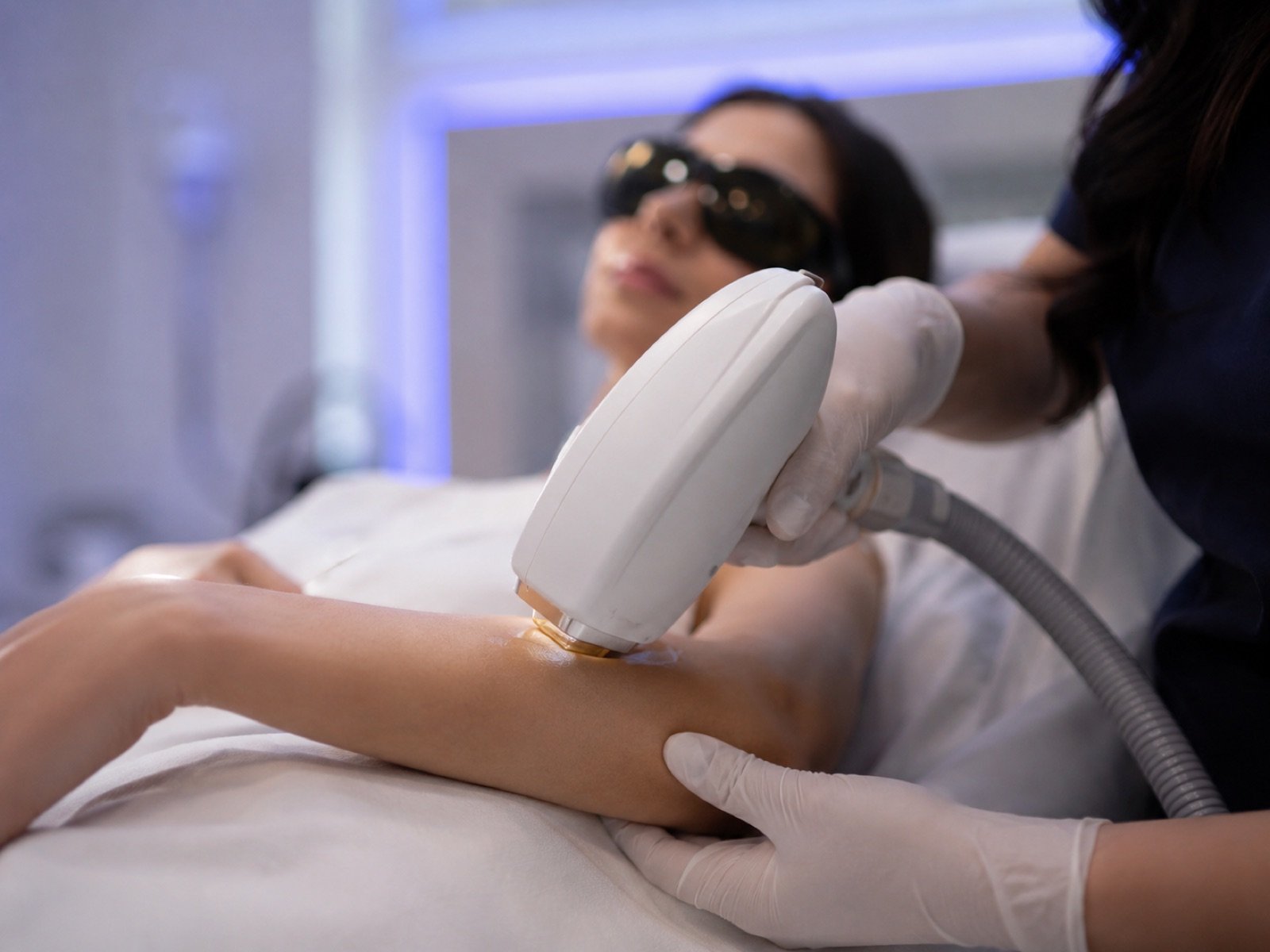
Laser hair removal at home vs in a clinic mostly comes down to three things: your skin tone, your hair, and how much area you want treated. With lighter skin, dark hair and a small area, a home device used exactly as directed can be reasonable. With medium to deep brown skin, an easy tan or larger areas, a clinic assessment is usually the more cautious start. Neither route removes hair for good in one go.
First, what these home devices actually are
Most home devices are IPL (intense pulsed light), and a few use a low-power laser. Both work like clinic treatment: pigment in the hair soaks up light and turns it into heat, which damages the follicle so regrowth is slower and finer.
The big difference is power. Home devices are built for untrained people to use alone, so each flash carries far less energy. That keeps them gentler, but results are slower, and some skin tones cannot use them at all.
If a service brings a machine to your house instead, treat it like a clinic visit and ask who is trained, how settings are chosen for your skin, whether eye protection is used, and who to call if you react.
Do at-home IPL or laser devices work on Indian skin tones?
It depends on your hair and where you sit in the wide range of Indian skin tones. Light-based hair removal works most reliably when dark hair sits on lighter skin. Skin with more melanin absorbs some of the light too, so it heats up, which raises the chance of burns, blistering or patches that turn darker or lighter.
That is why most devices carry a skin-tone chart, and many have a sensor that will not flash on skin it reads as too dark. With fair to wheatish skin and black hair, a device may reduce growth over a few months. With medium-brown to deep brown skin, it may block you or allow only its lowest levels, which often do very little. A tan counts too: after a summer of two-wheeler commutes, your arms may read darker than your stomach.
Who tends to get the least from a home device
- Deep brown skin, where the device is blocked or kept too low to do much.
- Grey, white, blonde or red hair, which has too little pigment to target (clinic lasers struggle here too).
- Fine, soft facial hair, which often responds poorly to low-energy light.
- Hormone-driven hair growth, for example with PCOS, where new hair keeps coming and the cause needs a doctor’s attention.
If that list sounds like you, having your skin and hair looked at in person is a sensible step before buying a device. Either way, if the manual’s skin-tone chart says your tone is not suitable, believe it. Overriding a safety sensor can lead to burns.
Is at-home laser hair removal safe?
Used as directed, on approved skin and hair types, home devices are generally low risk. Problems usually come from using them in the wrong place or too often. Redness and a warm, prickly feeling for a few hours are common. Burns, blisters and colour changes are less common but more serious, and more likely on darker or tanned skin. Rarely, hair near the treated area grows thicker instead. This has been reported with home and clinic treatment, more often on the face and neck and on darker skin.
Do not use a home device
- 1Near your eyes, on your eyebrows or eyelids. The flash can damage your eyes.
- 2Over tattoos, including cosmetic tattooing such as microbladed brows.
- 3Over moles, birthmarks, dark spots or any skin lesion that is changing.
- 4On skin that is sunburnt, freshly tanned, broken, infected or has active eczema.
- 5If you are pregnant or breastfeeding. Most manuals say not to use the device at all.
- 6If you are taking, or recently stopped, isotretinoin for acne, or other medicines that make skin sensitive to light. Check with your doctor first.
- 7If you have waxed, threaded, plucked or bleached the area in the last few weeks. The light needs the root and its pigment, so shave instead.
- 8Without asking a doctor first if you get keloids or raised scars, have had skin cancer, have epilepsy triggered by flashing light, or recently had a peel or used retinoid creams on the area.
Whether at home or in a clinic, keep treated areas out of strong sun and use a broad-spectrum sunscreen for a couple of weeks before and after each session. Tanned skin is more likely to burn or develop dark patches.
What is different in a clinic session?
Here is what usually happens in a clinic that a home device cannot do for you.
What a clinic session adds
- A look at your skin tone, any recent tan, your hair and any marks or moles in the area first.
- Questions about medicines, hormonal conditions, pregnancy and past reactions, because they change what is safe.
- Settings adjusted for your skin and each body area, and changed between sessions based on how you responded.
- Cooling during treatment on most clinic systems, which protects the skin surface and eases discomfort.
- Eye protection for you and the person treating you.
- Someone watching your skin who can lower the settings or stop if it reacts.
A home session on both legs takes a good while, every week or two at first; in a clinic, large areas are covered faster. The trade-off is that you have to fit appointments in, and a clinic course is planned as a course rather than a one-time purchase.
Home device vs clinic: a quick comparison
“A home IPL device does the same job as a clinic laser.”
It works on a similar principle at much lower energy, with no one assessing your skin. Results are usually slower and more modest, with ongoing top-ups.
“If the sensor lets it flash, the setting must be right for me.”
A sensor only checks tone at that spot. It knows nothing about your medicines or how your skin reacted last time. Start low and stop if the skin reacts.
“Higher settings at home will speed things up.”
Pushing the highest level on skin that is darker or tanned is a common route to burns and patches. Follow the manual and build up slowly.
What to check before buying a device
Before you buy
- 1Does the skin-tone chart include your tone, and does the device have a skin sensor?
- 2Does it cover your hair colour? Grey, blonde and red hair will not respond.
- 3Is it approved for the areas you want to treat? Most home devices are not meant for use above the cheekbones or around the eyes, on nipples or the genital area, and some are not meant for the face at all. Check the manual.
- 4Is it from an authorised seller with warranty and service support in India? Cheap copies may lack a reliable safety sensor.
- 5How many flashes does the lamp last, and can you get replacements here?
- 6Are you ready for regular use over a few months, then top-ups?
If you move from a home device to a clinic
Worth mentioning at your first visit
- Which device you have used, on which areas, and when you last used it.
- Any lingering redness, marks, colour changes or thicker hair.
- Whether you should stop using the device while the clinic course is going on.
When to stop and see a doctor
Whichever route you choose, stop and get checked if you notice blisters, crusting, worsening swelling, patches darker or lighter than the skin around them, or hair getting thicker or darker near the treated area. Do not keep treating the spot to “even it out”. For a burn, cool it under running water for several minutes, do not pop any blisters, and get it checked. If the flash goes near your eyes and you notice pain, blurred vision or spots, see an eye doctor the same day.
See a doctor before starting if your hair growth has changed recently, you are unsure why it is growing, or you are not sure a mark in the area is harmless.
So which one should you choose?
A home device suits people with lighter skin, dark hair, a small area and the patience for regular use. If your skin is medium to deep brown, you tan easily, your hair growth has changed or you want large areas done, getting your skin assessed in a clinic first is usually the more cautious start. Some people do both: a clinic course, then a home device for touch-ups if their skin tone allows it.
If you are in Noida or Ghaziabad and unsure where you fit, you can book a laser hair removal consultation at our Noida Sector 50 or Indirapuram clinic. In the south, the same conversation can happen at our Banjara Hills clinic in Hyderabad or our Rajajinagar clinic in Bengaluru. The team can look at your skin and hair and talk through whether laser hair removal is likely to suit you.
Quick answers
Is laser hair removal at home as good as in a clinic?
Usually not. Home devices use much lower energy, so results tend to be slower and more modest, with regular top-ups. In a clinic, settings can be adjusted for your skin and changed if it reacts. Results vary from person to person either way.
Can I use an IPL hair removal device at home on brown Indian skin?
It depends on how deep your skin tone is. Many devices are designed for light to medium skin and block or limit use on deeper brown skin, where burns and dark patches are more likely. If the manual’s chart does not list your tone as suitable, do not use it.
Is at-home laser hair removal safe?
Used exactly as the manual says, on approved skin and hair types, they are generally low risk. Problems come from use near the eyes, over tattoos or moles, on tanned skin, while on isotretinoin or similar medicines, or at settings too high for you. Stop and see a doctor if you get blisters or colour changes.
Do home IPL devices get rid of hair for good?
No. They can reduce and thin hair with regular use, but hair usually returns if you stop completely, so touch-ups are needed. Clinic treatment also aims for long-term reduction, not a promise that no hair will ever return.
Why do some people see no result from a home device?
Common reasons are grey, blonde, red or very fine hair, skin too deep for useful settings, irregular use, and hormone-driven growth (for example with PCOS) that keeps producing new hair.
Book laser hair removal at a clinic near you
This guide is general information, not medical advice; individual results and suitability vary. For advice about your own skin or hair, book a consultation at any Perfect 5 Clinic.